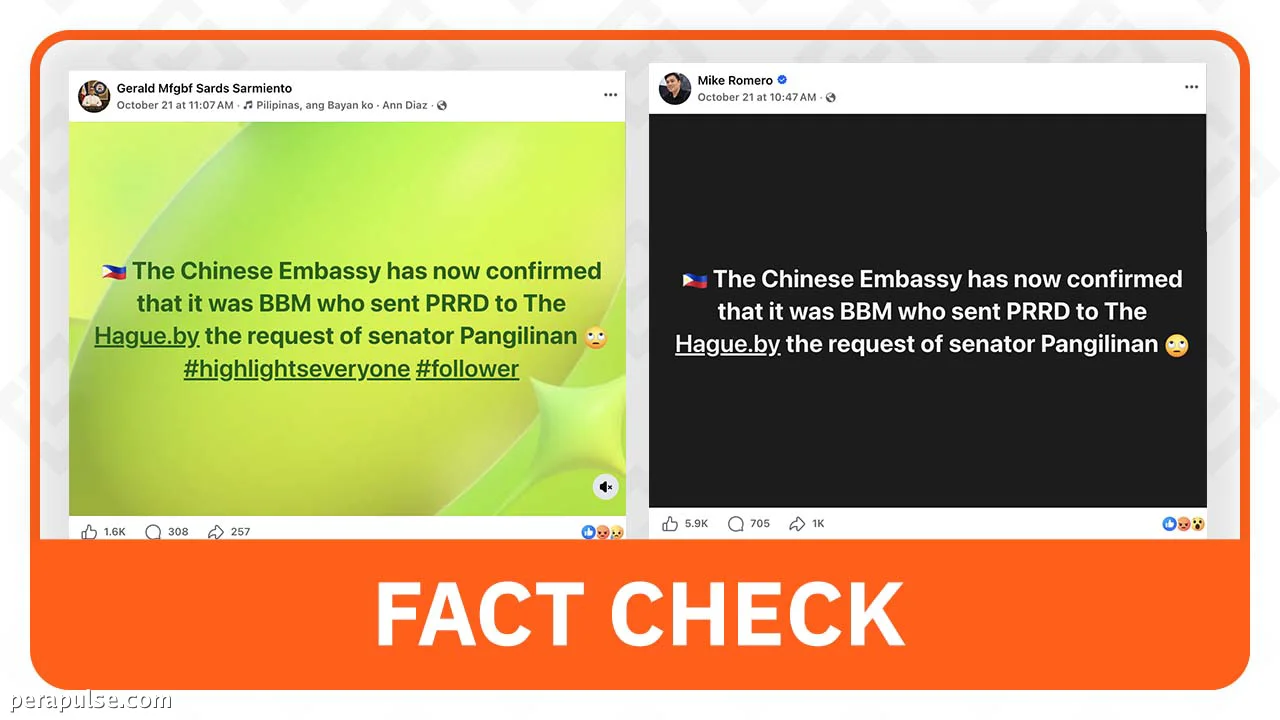
The Chinese embassy in Manila has explicitly denied assertions suggesting that President Ferdinand Marcos Jr. orchestrated the arrest of former President Rodrigo Duterte at the behest of Senator Kiko Pangilinan. These claims gained traction on social media following Pangilinan's comments concerning the embassy.
Clarification from the Chinese Embassy
Using thuggish, hooligan-style language to launch personal attacks on others—is this the calibre and standards of a Philippine senator? Is this the diplomacy and prudence that the DFA claims to uphold?
Chinese Embassy
Claims circulating online allege that the embassy confirmed a request from Pangilinan for Marcos to send Duterte to The Hague. However, the embassy's response was rhetorical and did not substantiate any collusion or requests regarding Duterte’s arrest.
Duterte's arrest in March 2025 followed an International Criminal Court (ICC) warrant for crimes against humanity. The ICC has continuously rejected any allegations of collusion with the Philippine government.
The embassy's remarks came after Pangilinan publicly criticized the Chinese Ambassador Jing Quan, suggesting he be sent back to China. The embassy's rebuttal emphasized the inappropriateness of the senator's language rather than addressing the specifics of Duterte's situation.
In the context of ongoing tensions between the Philippines and China, particularly regarding the West Philippine Sea, the embassy's communications have increasingly taken a confrontational tone. This latest incident reflects the complex diplomatic dynamics characterizing their bilateral relations.
As the ICC prepares for the trial of Duterte, which is set to commence on November 30, 2026, the political ramifications of these unfounded claims may continue to unfold, emphasizing the need for accurate information in public discourse.