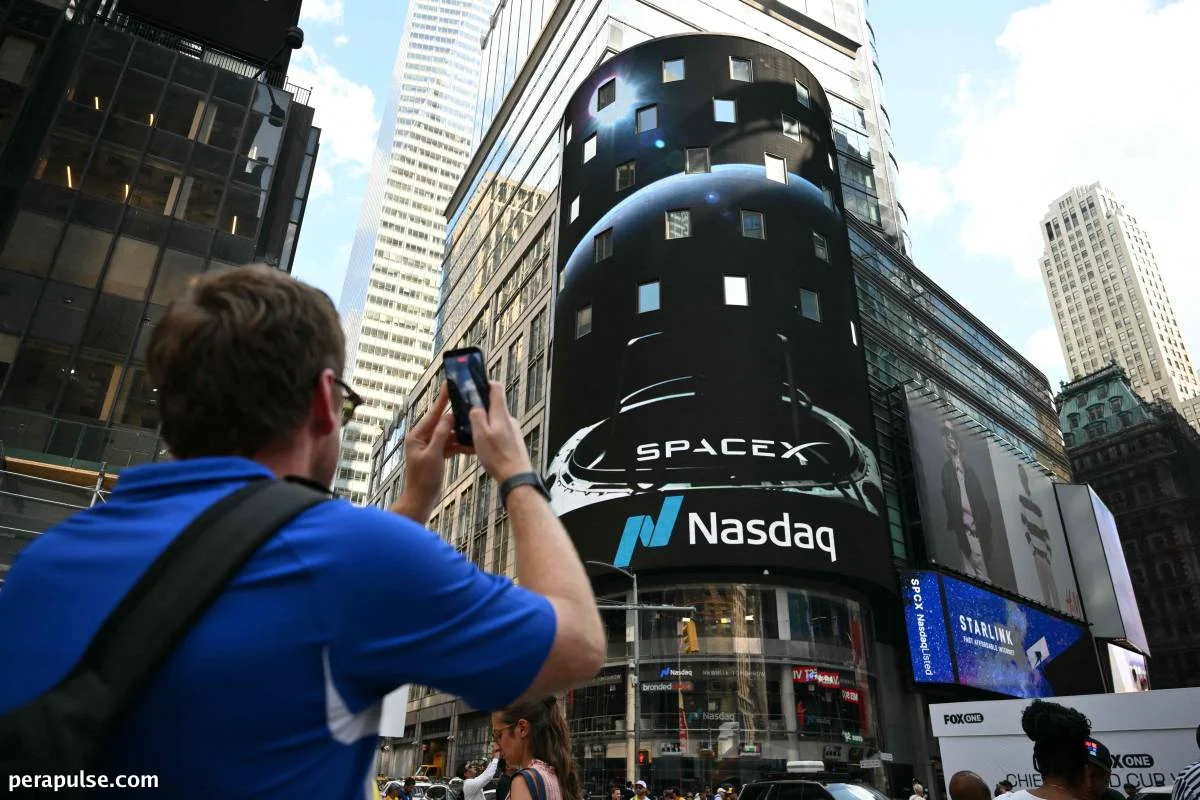
Elon Musk has officially become the world's first trillionaire, following the remarkable initial public offering (IPO) of his aerospace company SpaceX. The shares surged over 19% on their opening day, highlighting substantial investor enthusiasm.
A Record-Breaking IPO
There’s a lot of hype, but I see the faith that investors have in Musk.
Yordys Coro, IT Support Contractor
The stock debuted at $150 and ended the day near $161, giving the company a market value of $2.1 trillion. This valuation places SpaceX as the sixth largest public company in the U.S., surpassing even Tesla, another of Musk's ventures.
Musk's decision to go public is driven by the need for capital to fund ambitious projects, including satellite deployment and future Mars colonization. He celebrated the IPO by ringing the ceremonial bell at Nasdaq from SpaceX's Starbase in South Texas.
Despite the excitement, analysts have voiced skepticism. Morningstar analysts argue that SpaceX's stock is significantly overvalued, estimating a worth of only $780 billion due to ongoing technological challenges.
Since its inception in 2002, SpaceX has faced substantial financial losses, reporting an $8.7 billion deficit from early 2025 to March 2026. Investors, however, seem undeterred, driven by Musk's reputation for innovation.
Musk's wealth is largely tied to his ownership stakes in SpaceX and Tesla. He holds 82% of a special class of shares in SpaceX, allowing him significant control despite owning a smaller portion overall. This structure has raised concerns among shareholder advocates.
While Musk has successfully navigated challenges before, the road ahead for SpaceX includes significant hurdles, particularly in its AI initiatives and the management of its ambitious goals.
The IPO marks the first of three expected major public offerings this year, with competitors Anthropic and OpenAI set to follow. Nasdaq has adjusted its rules to facilitate quicker inclusion of SpaceX in various index funds, further propelling its stock's visibility.